

A fire door’s ability to stay closed and operate safely depends directly on its locking hardware. On Dimak fire doors, the lock comprises three parts that work together: the mortise lock body that keeps the door closed, the Euro-profile cylinder that provides keyed access, and the electrical strike that lets the door integrate with access control systems. This page explains the technical characteristics of each part, how it works, and how they work as a set.
The Dimak fire door lock is a small-body mortise lock, suitable for fire door applications, that is both reversible and dual-function. Being reversible, it can be used on both right-hand and left-hand opening doors. The lock can be configured as panic or anti-panic by means of a set screw, so it adapts to the door’s use scenario.
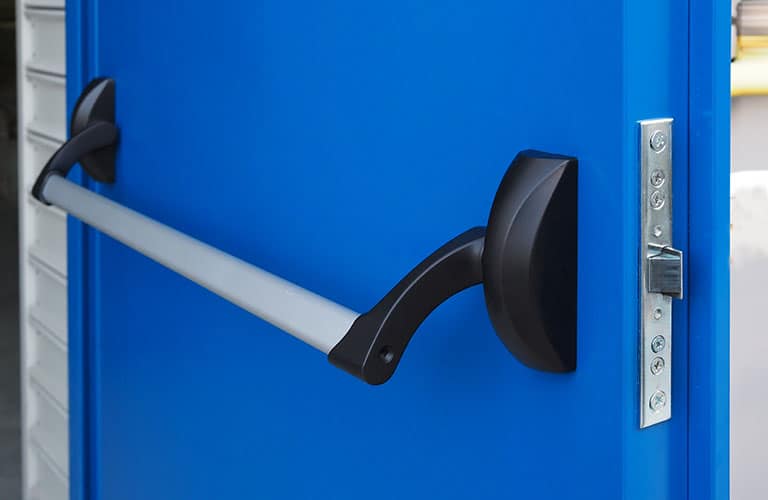
The lock’s steel latch is resistant to temperatures above 1000 °C, which is critical for keeping the latching function intact during a fire. The body uses zinc-coated steel. The panic bar or handle set is fitted as a monoblock with four screws running the full length; this connection increases the hardware’s durability under demanding conditions and prevents tearing on the door surface.
| Characteristic | Value |
|---|---|
| Application | Fire doors |
| Door direction | Reversible (right and left hand) |
| Function | Dual-function; panic / anti-panic via set screw |
| Backset (faceplate to cylinder centre) | 65 mm |
| Square spindle | 8 x 8 mm |
| Steel latch | Resistant above 1000 °C |
| Body / plate | Zinc-coated steel |
| Mounting | Monoblock, four full-length screws |
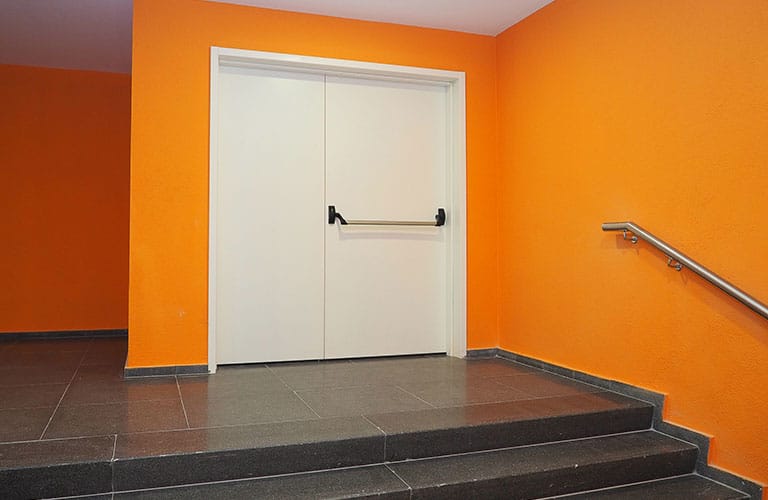
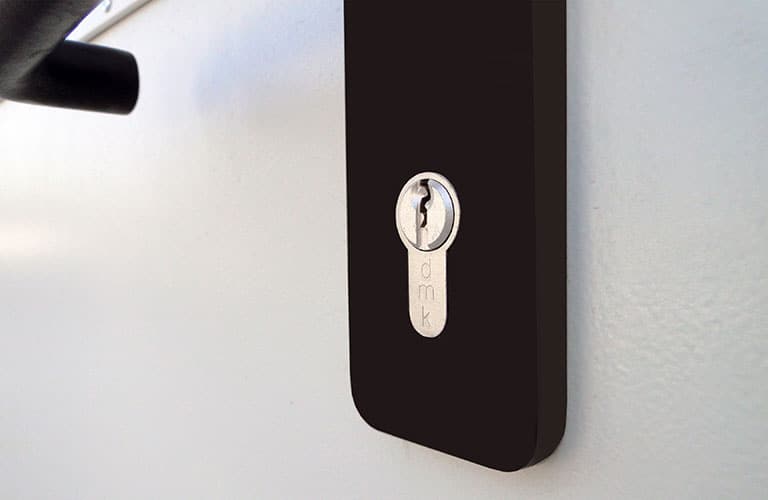
The Dimak fire door lock is designed for use with a Euro-profile cylinder. Two cylinder configurations are possible: a full cylinder, used with the handle set, and a half cylinder, used together with a handle and panic bar. This flexibility lets the door be configured for both keyed access control and emergency egress requirements. See the cylinder technical document (PDF). Where emergency exit hardware is required, it is considered together with the single leaf panic hardware fire door and double leaf panic hardware fire door solutions.
The electrical strike is the electrified hardware that lets a fire door integrate with access control systems such as card entry and remote release. Thanks to its reversibility, it is suitable for both right-hand and left-hand opening doors. Fail-safe and fail-secure settings are made by changing the screw positions; this setting determines whether the door stays locked or stays open during a fire. A cutting plate is available if cutting is required.
| Characteristic | Value |
|---|---|
| Voltage (VDC) | 12, 24 or dual 12/24 |
| Gap | 9/16″ (15 mm) |
| Frame | Metal |
| Mounting | Mortise |
| Body | Zinc-alloy stainless steel |
| Static holding force | 454 kg |
| Dynamic force | 68 Nm |
| Durability (opening cycles) | UL tested 250,000; manufacturer factory test 1,000,000 |
| Finish | Brushed stainless steel (US32D) |
| Standard / certification | UL1034 burglary resistance (BP10269); CE: EC741012-01 |
The electrical strike can be configured in two operating modes. In fail-secure (power to open), the door is normally locked and power is applied to open it; if power is lost, the door stays locked. In fail-safe (power to lock), power is required to keep it locked; if power is lost, the door can be opened. Which mode is chosen depends on the building’s fire and security scenario, and it is set by the screw position.
On Dimak fire doors, the lock is not shipped fitted to the door; it is delivered inside the accessory box. On site, the lock direction is set according to the door’s opening direction and the lock is installed. The installation steps are shown in the fire door installation manual (PDF); see also our fire door installation guide for the overall process.
The cylinder length is chosen according to the hardware on the door:
| Door hardware | Cylinder length |
|---|---|
| Door with panic bar | 60 mm |
| Door with lever handles on both sides | 81 mm |
When the lock or other accessories need to be replaced, spare parts are supplied by Dimak. The existing accessories are removed and the new accessories are fitted as shown in the installation manual.
Dimak doors are manufactured to suit Dimak locks and accessories. If different accessories are to be used in a project, this must be stated at the order stage and approved.
The lock, cylinder and electrical strike each work as part of the fire door system. The door’s overall fire resistance class is determined by the certification of the complete door assembly under EN 1634-1. We explain what a fire resistant door is in a dedicated guide. To keep the lock and other moving hardware performing, do not neglect periodic maintenance and inspections.
For how the door works, see our what is a fire door guide; for the component that handles closing, see the fire door hinge page; and for all hardware and accessories, see the fire door hardware page.
Dimak fire doors use a reversible, dual-function, small-body mortise lock suitable for a Euro-profile cylinder. Its steel latch is resistant above 1000 °C and the backset is 65 mm.
Yes. The lock can be set to panic or anti-panic via a set screw; the half cylinder is used together with a handle and panic bar.
Yes. With an electrical strike, a fire door can integrate with access control systems such as card entry and remote release. Static holding force is 454 kg and dynamic force is 68 Nm.
In fail-secure (power to open), the door is normally locked and stays locked if power is lost. In fail-safe (power to lock), the door can be opened if power is lost. The mode is set by the screw position.
A Euro-profile cylinder is used. The full cylinder is used with the handle set, and the half cylinder is used together with a handle and panic bar.
On Dimak fire doors, the lock is delivered in the accessory box and installed on site, with the lock direction set according to the door’s opening direction. The installation steps are shown in the Dimak fire door installation manual.
A 60 mm cylinder is used on doors with a panic bar, and an 81 mm cylinder on doors with lever handles on both sides.
Dimak doors are manufactured to suit Dimak locks and accessories. If different accessories are to be used in a project, this must be stated at the order stage and approved.
Let’s determine the right locking and access configuration for your project together. The Dimak Door team supports you on the lock, cylinder and electrical strike selection. Get in touch.